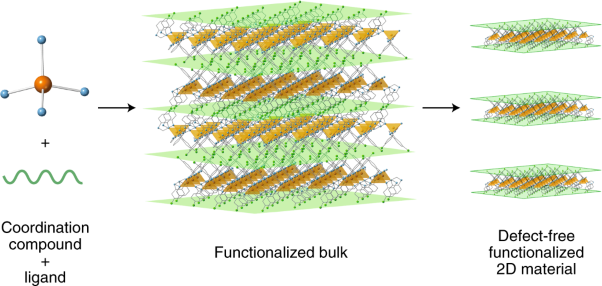
Surface engineering is an attractive route to tune the processability, stability and functionalities of 2D materials, but typically introduces defects in the resulting structures. Now, the issue has been circumvented through pre-synthetic functionalization instead; an isoreticular family of robust layered coordination polymers has been mechanically exfoliated to give functionalized crystalline magnetic monolayers.
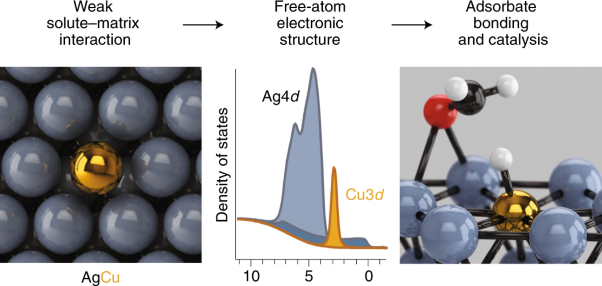
In solid metals, electron orbitals form broad bands and their binding of adsorbates depends on the bandwidth. Now, it is shown that a weak solute–matrix interaction in dilute alloys results in extremely narrow electronic bands on the solute, similar to a free-atom electronic structure. This structure affords unique adsorption properties important for catalysis.
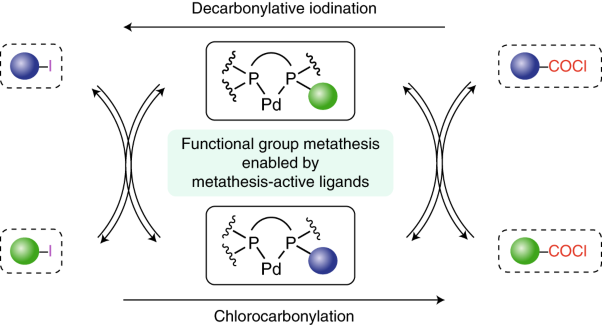
Functional group interconversion typically requires reactive reagents to irreversibly generate a desired product in high yield and selectivity. Now, a CO-free catalytic functional-group-metathesis approach can be used to interconvert aroyl chlorides and aryl iodides—two important classes of electrophiles often employed in the preparation of pharmaceuticals and agrochemicals—with the help of metathesis-active phosphine ligands.
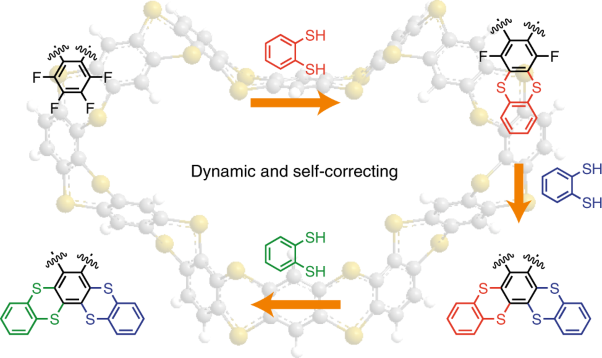
Dynamic covalent chemistry offers promise for the formation of elaborate extended network materials in high yields, but the limited number of reactions available confines the scope and functionality of the materials synthesized. Now, nucleophilic aromatic substitution has been shown to be reversible, and thus self-correcting, enabling the easy synthesis of sulfur-rich materials.
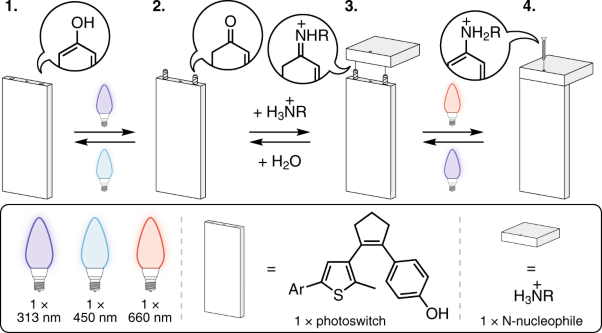
Light can selectively drive and control the reversible reaction between a nitrogen nucleophile and a photoswitchable carbonyl electrophile by inducing wavelength-specific tautomerization cycles. This enables external and bidirectional regulation of closed dynamic covalent systems via C=N exchange, resembling a light-powered bidirectional molecular-scale Dean–Stark trap.
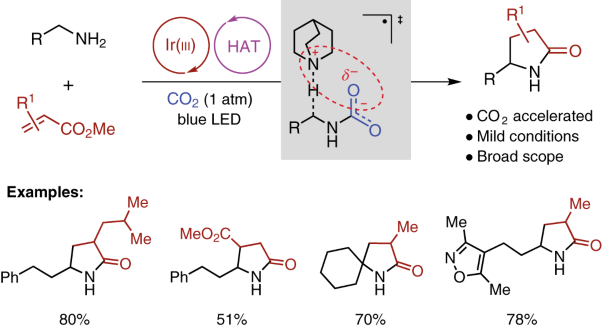
CO2 can be used as an activator for the direct transformation of abundant and unprotected primary aliphatic amines into valuable γ-lactams under photoredox and hydrogen-atom-transfer catalysis. Electrostatic interactions between the in situ generated alkylammonium carbamate and the positively charged quinuclidinium radical lead to regioselective hydrogen atom abstraction.
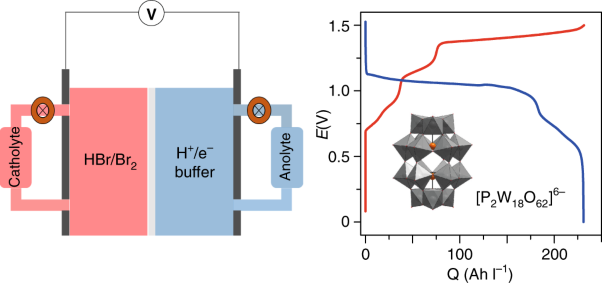
The polyoxoanion [P2W18O62]6− has been shown to reversibly accept up to 18 electrons upon reduction in aqueous solution. The resulting highly reduced solution can then be used either for the on-demand generation of hydrogen over a catalyst bed, or as a high-energy-density electrolyte in a redox flow battery.
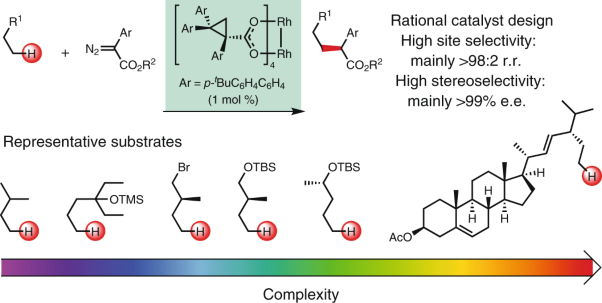
Catalyst-controlled site selectivity without relying on the influence of a directing group within the substrate is a major challenge in C–H functionalization. Now a catalyst is described that selectively functionalizes non-activated primary C–H bonds in the presence of a variety of other C–H bonds and functional groups.
Layered coordination polymers are attractive for the preparation of advanced 2D materials but they are typically non-magnetic insulators. Now such a layered network, CrCl2(pyrazine)2, has been prepared that comprises a paramagnetic metal ion and a redox-active ligand. The material exhibits both magnetism — with a ferrimagnetic ground state — and high electrical conductivity.
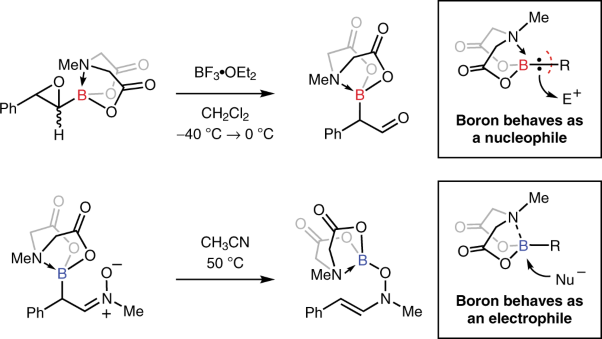
Mechanistic studies of the hemilability of MIDA (N-methyliminodiacetic acid) boronates reveal the chameleonic behaviour of the BMIDA group. The superior migratory aptitude of BMIDA compared to hydride and the capacity to resemble a proton when nitrogen decoordinates from boron have now been exploited for the design of new boron transfer reactions.
Nature Briefing is an essential round-up of science news, opinion and analysis, free in your inbox every weekday. With Nature Briefing, we'll keep you updated on the latest research, so you can focus on yours.
Natureevents is a fully searchable, multi-disciplinary database designed to maximise exposure for events organisers. The contents of the Natureevents Directory are now live. The digital version is available here. Find the latest scientific conferences, courses, meetings and symposia on natureevents.com. For event advertising opportunities across the Nature Publishing Group portfolio please contact natureevents@nature.com
You have been sent this Table of Contents Alert because you have opted in to receive it. You can change or discontinue your e-mail alerts at any time, by modifying your preferences on your nature.com account at: www.nature.com/myaccount (You will need to log in to be recognised as a nature.com registrant)
Springer Nature | One New York Plaza, Suite 4500 | New York | NY 10004-1562 | USA
Springer Nature's worldwide offices: London - Paris - Munich - New Delhi - Tokyo - Melbourne San Diego - San Francisco - Washington - New York - Boston
Macmillan Publishers Limited is a company incorporated in England and Wales under company number 785998 and whose registered office is located at The Campus, 4 Crinan Street, London, N1 9XW.















No comments:
Post a Comment