Wednesday, September 19, 2018

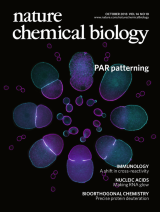
Nature Chemical Biology Contents: October 2018, Volume 14 No 10

If you are unable to see the message below, click here to view.
Nature Chemical Biology

Advertisement

The power and performance of our Library of Pharmacologically Active Compounds is assured.

  • 1,280 pharmacologically active compounds
  • Ready-to-use DMSO stocks: less time-consuming sample preparation
  • Highly pure compounds with full QC: re-supply as individual catalog items 

Learn More

TABLE OF CONTENTS

October 2018 Volume 14, Issue 10

Research Highlights
News & Views
Articles
Amendments & Corrections
 
Advertisement
Meet the shortlist!

The shortlist for this year's Nature Research Awards for Inspiring Science and Innovating Science has been announced. These Awards showcase exceptional achievements of leading women in science and of those who have encouraged girls and women to engage with STEM subjects.

See more about our shortlisted nominees >

In partnership with The Estée Lauder Companies.


Research Highlights


PUP up the volume    p903
Caitlin Deane
doi:10.1038/s41589-018-0138-9

Cost–benefit analysis    p903
Grant Miura
doi:10.1038/s41589-018-0139-8

Fatal chemoattraction    p903
Mirella Bucci
doi:10.1038/s41589-018-0140-2

Diversifying bases    p903
Yiyun Song
doi:10.1038/s41589-018-0141-1

Nature Chemical Biology
JOBS of the week
Research Fellow
Dana-Farber Cancer Institute (DFCI)
Natural Product Chemist And Chemical Biology Postdoc Fellowship
McMaster University
Postdoctoral researcher (m / f) in Stem cell based in vitro disease modeling
University of Luxembourg - The Luxembourg Centre for Systems Biomedicine (LCSB)
Post Doctoral Position
IGBMC
Postdoc (m / f): Production of Monoclonal Antibodies using Humanized Mice
Hannover Medical School (MHH)
More Science jobs from
Nature Chemical Biology
EVENT
International Conference on Chemical and Biological Sciences 2018
23.11.18
Kuala Lumpur, Malaysia
More science events from

News & Views


A new target for thalidomide    pp904 - 905
Peter G. Wells
doi:10.1038/s41589-018-0134-0

Flipping out the peptide    pp905 - 906
Stephanie Gras
doi:10.1038/s41589-018-0133-1

The substrate lends a hand    pp907 - 908
Albert A. Bowers
doi:10.1038/s41589-018-0135-z

 
Advertisement
Do you have a career question? 

The Naturejobs podcast features one-on-one Q&As, panel discussions and other exclusive content to help scientists with their careers. Hosted on the Naturejobs blog, the podcast is also available on iTunes and Soundcloud. 

Listen today!
 

Articles


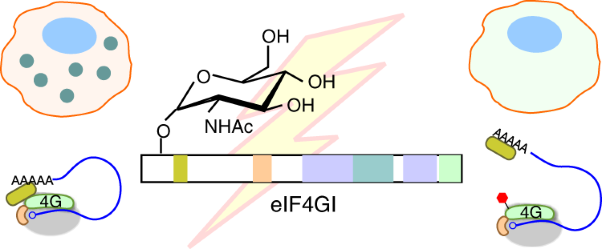
O-GlcNAc modification of eIF4GI acts as a translational switch in heat shock response    pp909 - 916
Xingqian Zhang, Xin Erica Shu & Shu-Bing Qian
doi:10.1038/s41589-018-0120-6

O-GlcNAcylation of translation initiation factor component eIF4GI blocks interactions to poly(A)-binding protein Pab1 to induce disassembly of stress granules, releasing Hsp70-induced mRNAs and leading to translation of protective proteins


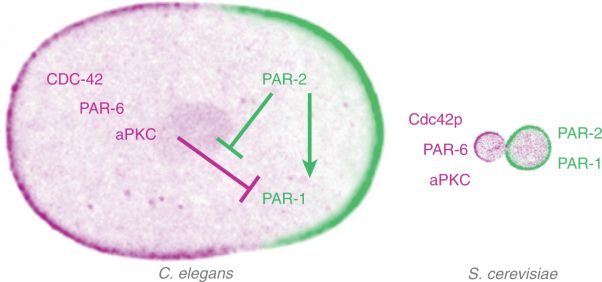
Establishment of the PAR-1 cortical gradient by the aPKC-PRBH circuit    pp917 - 927
Ravikrishna Ramanujam, Ziyin Han, Zhen Zhang, Pakorn Kanchanawong & Fumio Motegi
doi:10.1038/s41589-018-0117-1

The asymmetric cortical gradient of PAR-1 is patterned via an integration of its cortical exclusion and stabilization by a circuit consisting of aPKC and the PRBH protein PAR-2.


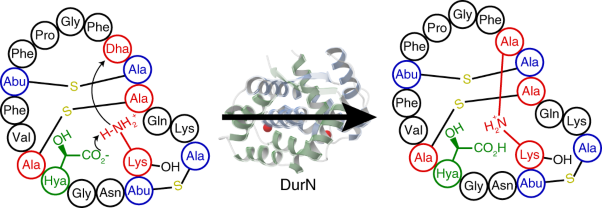
Substrate-assisted enzymatic formation of lysinoalanine in duramycin    pp928 - 933
Linna An, Dillon P. Cogan, Claudio D. Navo, Gonzalo Jiménez-Osés, Satish K. Nair et al.
doi:10.1038/s41589-018-0122-4

During the biosynthesis of the lanthipeptide duramycin, DurN catalyzes stereospecific lysinoalanine formation by preorganizing the reactive conformation of the substrate, such that one of the substrate’s own residues serves as the catalytic base.


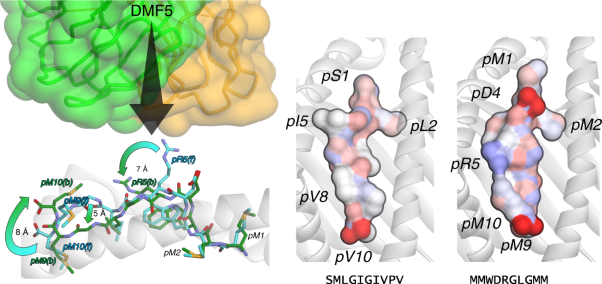
T cell receptor cross-reactivity expanded by dramatic peptide–MHC adaptability    pp934 - 942
Timothy P. Riley, Lance M. Hellman, Marvin H. Gee, Juan L. Mendoza, Jesus A. Alonso et al.
doi:10.1038/s41589-018-0130-4

Structural analysis shows that cross-reactivity of the T cell receptor DMF5 is governed by adaptability of the peptide antigen, which can undergo TCR-binding-induced frameshifting forcing the peptide C terminus to extend from the MHC-binding groove.


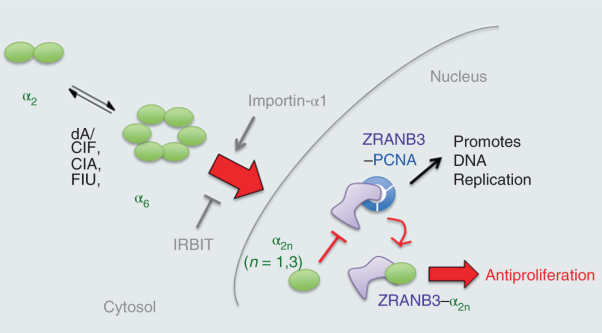
Nuclear RNR-α antagonizes cell proliferation by directly inhibiting ZRANB3    pp943 - 954
Yuan Fu, Marcus J. C. Long, Somsinee Wisitpitthaya, Huma Inayat, Timothy M. Pierpont et al.
doi:10.1038/s41589-018-0113-5

The large subunit of ribonucleotide reductase RNR-α downregulates DNA replication in the nucleus by directly disrupting PCNA and ZRANB3 interactions. RNR-α nuclear entry is regulated by an interplay between IRBIT and importin-α1.


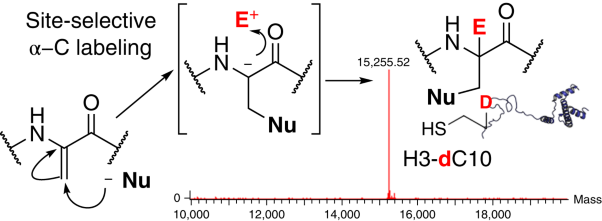
Post-translational site-selective protein backbone α-deuteration    pp955 - 963
Sébastien R. G. Galan, James R. Wickens, Jitka Dadova, Wai-Lung Ng, Xinglong Zhang et al.
doi:10.1038/s41589-018-0128-y

A chemical method for site-selective deuterium exchange at protein backbone α-carbons, involving conversion of cysteine to dehydroalanine and then to deuterated cysteine, is used to explore the mechanism of a model protein bioconjugation reaction.


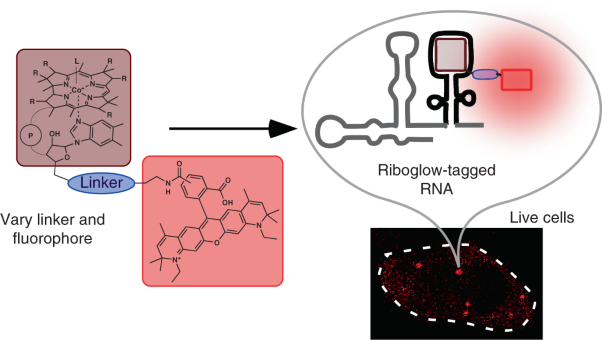
A multicolor riboswitch-based platform for imaging of RNA in live mammalian cells    pp964 - 971
Esther Braselmann, Aleksandra J. Wierzba, Jacob T. Polaski, Mikołaj Chromiński, Zachariah E. Holmes et al.
doi:10.1038/s41589-018-0103-7

A new riboswitch-based RNA sensor called Riboglow binds to quenched fluorescent probes to induce fluorescence turn-on. Riboglow enables tagging and tracking of mRNA and short noncoding RNAs with different colored fluorophores in live mammalian cells.


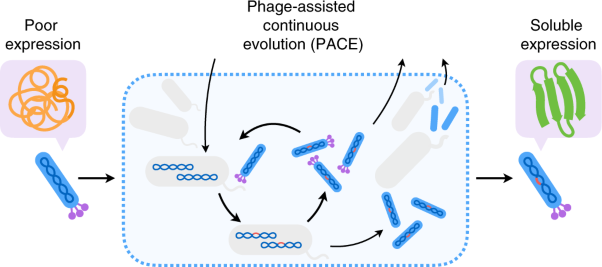
Continuous directed evolution of proteins with improved soluble expression    pp972 - 980
Tina Wang, Ahmed H. Badran, Tony P. Huang & David R. Liu
doi:10.1038/s41589-018-0121-5

Through use of a split-intein pIII, soluble expression phage-assisted continuous evolution (SE-PACE) enables two simultaneous positive selections to rapidly evolve proteins with improved expression while maintaining their desired activities.


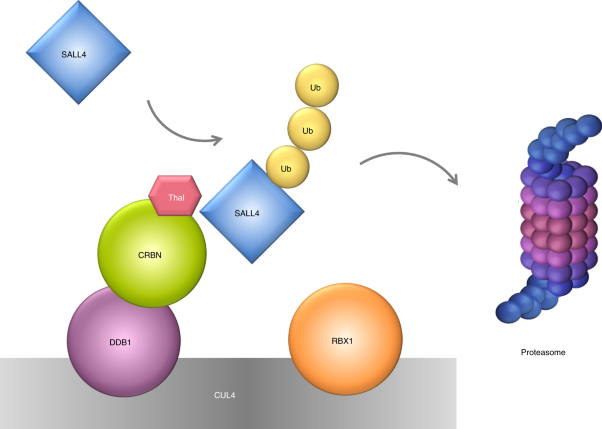
SALL4 mediates teratogenicity as a thalidomide-dependent cereblon substrate    pp981 - 987
Mary E. Matyskiela, Suzana Couto, Xinde Zheng, Gang Lu, Julia Hui et al.
doi:10.1038/s41589-018-0129-x

Thalidomide-induced degradation of the transcription factor SALL4 in a cereblon-dependent manner provides an explanation for the teratogenic effects.


Amendments & Corrections


Publisher Correction: Evolution of chalcone isomerase from a noncatalytic ancestor    p988
Miriam Kaltenbach, Jason R. Burke, Mirco Dindo, Anna Pabis, Fabian S. Munsberg et al.
doi:10.1038/s41589-018-0079-3

Publisher Correction: The Jumonji-C oxygenase JMJD7 catalyzes (3S)-lysyl hydroxylation of TRAFAC GTPases    p988
Suzana Markolovic, Qinqin Zhuang, Sarah E. Wilkins, Charlotte D. Eaton, Martine I. Abboud et al.
doi:10.1038/s41589-018-0104-6

Advertisement
Nature Briefing is an essential round-up of science news, opinion and analysis, free in your inbox every weekday. With Nature Briefing, we'll keep you updated on the latest research, so you can focus on yours.

Click here to sign up.
 
nature events
Natureevents is a fully searchable, multi-disciplinary database designed to maximise exposure for events organisers. The contents of the Natureevents Directory are now live. The digital version is available here.
Find the latest scientific conferences, courses, meetings and symposia on natureevents.com. For event advertising opportunities across the Nature Publishing Group portfolio please contact natureevents@nature.com
More Nature Events

You have been sent this Table of Contents Alert because you have opted in to receive it. You can change or discontinue your e-mail alerts at any time, by modifying your preferences on your nature.com account at: www.nature.com/myaccount
(You will need to log in to be recognised as a nature.com registrant)

For further technical assistance, please contact our registration department

For print subscription enquiries, please contact our subscription department

For other enquiries, please contact our customer feedback department

Springer Nature | One New York Plaza, Suite 4500 | New York | NY 10004-1562 | USA

Springer Nature's worldwide offices:
London - Paris - Munich - New Delhi - Tokyo - Melbourne
San Diego - San Francisco - Washington - New York - Boston

Macmillan Publishers Limited is a company incorporated in England and Wales under company number 785998 and whose registered office is located at The Campus, 4 Crinan Street, London, N1 9XW.

Nature is part of Springer Nature. © 2018 Springer Nature Limited. All rights reserved.

Springer Nature

No comments: