Advertisement |
 |
Meet the shortlist!
The shortlist for this year's Nature Research Awards for Inspiring Science and Innovating Science has been announced. These Awards showcase exceptional achievements of leading women in science and of those who have encouraged girls and women to engage with STEM subjects.
See more about our shortlisted nominees >
In partnership with The Estée Lauder Companies. | | | |
|
 |
TABLE OF CONTENTS
|
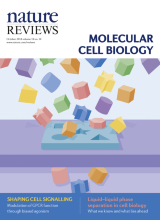
| October 2018 Volume 19, Issue 10 |
 | | |
 |  Comment Comment
Research Highlights
Reviews
Amendments & Corrections
| |
Comment | |
|
Why does biopolymer condensation matter?
Stephen W. Michnick & Louis-Philippe Bergeron-Sandoval
pp613 - 614 | doi:10.1038/s41580-018-0023-0
Biomolecules can phase separate and form condensates that have roles in diverse cellular processes and contexts. Michnick and Bergeron-Sandoval comment on this rapidly progressing field and envisage that the study of biological phase separation will bring new understanding of cell and developmental biology.
Full Text | PDF
|
Arrestins as rheostats of GPCR signalling
J. Silvio Gutkind & Evi Kostenis
pp615 - 616 | doi:10.1038/s41580-018-0041-y
G protein coupled receptors (GPCRs) transmit a variety of signals, mostly by engaging G proteins, but G protein-independent signalling through arrestins has also been demonstrated. Based on recent experimental evidence, Gutkind and Kostenis argue that arrestins serve as important signal modulators instead of as independent signal transducers.
Full Text | PDF
|
Research Highlights | |
|
A sugar rush of DNA methylation
Paulina Strzyz
p617 | doi:10.1038/s41580-018-0051-9
A new study in Nature identifies a molecular axis linking diabetes to cancer, whereby AMPK, which is inhibited in high glucose conditions, regulates the stability of TET2 DNA demethylase, thereby impacting DNA methylation and gene expression.
PDF
| Instructive power of senescence
David Bernard
p618 | doi:10.1038/s41580-018-0042-x
Senescent cells secrete a multitude of factors that modulate their local environment — a phenomenon known as senescence-associated secretory phenotype (SASP). David Bernard highlights that the SASP secretome can be flexibly regulated, resulting in different types of SASP, which contributes to the versatility of responses triggered by senescent cells.
PDF
| TUT-TUTting retrotransposons
Paulina Strzyz
p618 | doi:10.1038/s41580-018-0058-2
3′uridylation by TUT4 and TUT7 is shown as a post-transcriptional mechanism restricting retrotransposition of LINE-1 elements and also replication of animal RNA viruses.
PDF
| Not so CRISP(R)
Kim Baumann
p619 | doi:10.1038/s41580-018-0056-4
A study reports that CRISPR–Cas9 induces extensive on-target mutagenesis in mouse and human cells, calling for greater caution when using it in clinical contexts.
PDF
| Poly(dA:dT) make it and break it
Eytan Zlotorynski
p619 | doi:10.1038/s41580-018-0054-6
Poly(dA:dT) tracts characterize strong DNA replication origins in mammals and cause replication-fork collapse and DNA breaks that underlie the expression of fragile sites.
PDF
| | | | |
| Advertisement |
|
Do you have a career question?
The Naturejobs podcast features one-on-one Q&As, panel discussions and other exclusive content to help scientists with their careers. Hosted on the Naturejobs blog, the podcast is also available on iTunes and Soundcloud.
Listen today! |  | | |
|
| |
Reviews | |
|
Eukaryotic core promoters and the functional basis of transcription initiation
Vanja Haberle & Alexander Stark
pp621 - 637 | doi:10.1038/s41580-018-0028-8
Core promoters of RNA polymerase II enable highly regulated transcription initiation by integrating cues from distal enhancers. The emerging diversity of core promoters defines distinct transcription programmes and can explain the nature and outcome of transcription initiation at gene start sites and at enhancers.
Full Text | PDF
|
Mechanisms of signalling and biased agonism in G protein-coupled receptors
Denise Wootten, Arthur Christopoulos, Maria Marti-Solano, M. Madan Babu & Patrick M. Sexton
pp638 - 653 | doi:10.1038/s41580-018-0049-3
G protein-coupled receptors (GPCRs) control a plethora of signalling pathways in various contexts. Importantly, a single GPCR can elicit different responses depending on the bound ligand — a phenomenon known as biased agonism. Increasing molecular and structural understanding of biased agonism offers the possibility of designing improved GPCR-targeting drugs.
Full Text | PDF
|
Metabolites as regulators of insulin sensitivity and metabolism
Qin Yang, Archana Vijayakumar & Barbara B. Kahn
pp654 - 672 | doi:10.1038/s41580-018-0044-8
Metabolomics and lipidomics have enabled the identification of metabolites (such as lipids, amino acids and bile acids) and metabolic pathways that modulate insulin sensitivity both directly and indirectly. Understanding the metabolic adaptations involved in insulin resistance may lead to novel approaches for preventing and treating T2DM.
Full Text | PDF
Collection: Metabolic signalling
|
|
 |
Amendments & Corrections | |
|
Author Correction: Functional 5′ UTR mRNA structures in eukaryotic translation regulation and how to find them
Kathrin Leppek, Rhiju Das & Maria Barna
p673 | doi:10.1038/s41580-018-0055-5
Full Text | PDF
|
Author Correction: Sphingolipids and their metabolism in physiology and disease
Yusuf A. Hannun & Lina M. Obeid
p673 | doi:10.1038/s41580-018-0046-6
Full Text | PDF
|
| Advertisement |
|
Nature Briefing is an essential round-up of science news, opinion and analysis, free in your inbox every weekday. With Nature Briefing, we'll keep you updated on the latest research, so you can focus on yours.
Click here to sign up. |  | | |
|
| |
| | | | | | Natureevents is a fully searchable, multi-disciplinary database designed to maximise exposure for events organisers. The contents of the Natureevents Directory are now live. The digital version is available here.
Find the latest scientific conferences, courses, meetings and symposia on natureevents.com. For event advertising opportunities across the Nature Publishing Group portfolio please contact natureevents@nature.com | | | | | | |
|







No comments:
Post a Comment