Advertisement |
 |
Do you have a career question?
The Naturejobs podcast features one-on-one Q&As, panel discussions and other exclusive content to help scientists with their careers. Hosted on the Naturejobs blog, the podcast is also available on iTunes and Soundcloud.
Listen today! |  | | |
|
 |
TABLE OF CONTENTS
|
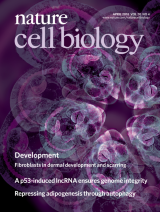
| April 2018 Volume 20, Issue 4 |
 | | |
 |  Editorial Editorial
Obituary
News & Views
Review Articles
Letters
Articles
Amendments & Corrections
| | | Advertisement | | | | Nikon's all-new A1R HD confocal features a High Definition 1K resonant scanner, which delivers high resolution images at ultra-high speed. The new scanner also provides 4x the field of view at the same resolution usually generated by a normal 512x512 scanner.
Learn more | | |
| |
Advertisement |
|
Advances in Translational Models to Study Fibrosis
April 17, 2018, NYC
Expert speakers from Weill Cornell Medicine, Tufts, Regeneron and more will review what is known about the cell and molecular biology of fibrosis and reparative healing, discuss current model systems, and consider the challenges and opportunities for future innovation.
Webinar available. Register. |  | | |
|
| |
| Advertisement |
|
| |
|
| |
Editorial | |
|
 |
|
| A PhD state of mind p363
doi:10.1038/s41556-018-0085-4 |
|
Obituary | |
|
|
|
| Günter Blobel (1936–2018) p364
André Hoelz
doi:10.1038/s41556-018-0081-8 |
|
News & Views | |
|
| |
Review Articles | |
|
|
|
| Emerging views of the nucleus as a cellular mechanosensor pp373 - 381
Tyler J. Kirby & Jan Lammerding
doi:10.1038/s41556-018-0038-y
Mechanical forces influence both cytoplasmic and nuclear events. Kirby and Lammerding discuss recent evidence suggesting that the nucleus itself is a mechanosensor and methods to study nuclear mechanotransduction. |
|
|
|
| Deconstructing the pluripotency gene regulatory network pp382 - 392
Mo Li & Juan Carlos Izpisua Belmonte
doi:10.1038/s41556-018-0067-6
Regulation of pluripotency: Li and Belmonte review the pluripotency gene regulatory network, the molecular principles of pluripotency gene function, regulation by RNA-binding proteins and alternative splicing, heterogeneity and alternative pluripotency states. |
|
Letters | |
|
|
|
| EFF-1 fusogen promotes phagosome sealing during cell process clearance in Caenorhabditis elegans pp393 - 399
Piya Ghose, Alina Rashid, Peter Insley, Meera Trivedi, Pavak Shah et al.
doi:10.1038/s41556-018-0068-5
Ghose et al. show that EFF-1 fusogen generates a sealed phagosome during engulfment of cells with long processes in Caenorhabditis elegans, and different mechanisms are required for soma, distal and proximal process clearance. |
|
| Advertisement |
|
| |
|
| |
Articles | |
|
|
|
| NCoR/SMRT co-repressors cooperate with c-MYC to create an epigenetic barrier to somatic cell reprogramming pp400 - 412
Qiang Zhuang, Wenjuan Li, Christina Benda, Zhijian Huang, Tanveer Ahmed et al.
doi:10.1038/s41556-018-0047-x
Zhuang et al. demonstrate that suppression of NCoR/SMRT enhances OSKM reprogramming efficiency, and that the barrier mechanism depends on the recruitment of HDAC3 to pluripotency loci by c-MYC. |
|
|
|
| Diminished apoptotic priming and ATM signalling confer a survival advantage onto aged haematopoietic stem cells in response to DNA damage pp413 - 421
Paula Gutierrez-Martinez, Leah Hogdal, Manavi Nagai, Miriama Kruta, Rumani Singh et al.
doi:10.1038/s41556-018-0054-y
Gutierrez-Martinez et al. show that an impaired DNA damage response and reduced apoptotic priming in old haematopoietic stem cells (HSCs) contribute to the survival and expansion of damaged HSCs in the bone marrow of aged mice. |
|
|
|
| Two succeeding fibroblastic lineages drive dermal development and the transition from regeneration to scarring pp422 - 431
Dongsheng Jiang, Donovan Correa-Gallegos, Simon Christ, Ania Stefanska, Juan Liu et al.
doi:10.1038/s41556-018-0073-8
Jiang et al. trace two embryonic fibroblast lineages in the mouse, one that does not express engrailed and mediates early dermal development and one that expresses engrailed and mediates scar tissue formation. |
|
|
|
| Daughter-cell-specific modulation of nuclear pore complexes controls cell cycle entry during asymmetric division pp432 - 442
Arun Kumar, Priyanka Sharma, Mercè Gomar-Alba, Zhanna Shcheprova, Anne Daulny et al.
doi:10.1038/s41556-018-0056-9
Kumar et al. discover a pathway that regulates asymmetric cell cycle entry in budding yeast through Hos3-mediated deacetylation of nucleoporins in daughter cells, which affects the localization of the cell cycle regulators Whi5 and Cln2. |
|
|
|
| TP53INP2 regulates adiposity by activating ß-catenin through autophagy-dependent sequestration of GSK3ß pp443 - 454
Montserrat Romero, Alba Sabaté-Pérez, Víctor A. Francis, Ignacio Castrillón-Rodriguez, Ángels Díaz-Ramos et al.
doi:10.1038/s41556-018-0072-9
Romero et al. show that the autophagy regulator TP53INP2 represses adipogenesis by promoting GSK3ß sequestration and activation of ß-catenin through an autophagy-dependent and ESCRT-dependent mechanism. |
|
|
|
| L3MBTL2 orchestrates ubiquitin signalling by dictating the sequential recruitment of RNF8 and RNF168 after DNA damage pp455 - 464
Somaira Nowsheen, Khaled Aziz, Asef Aziz, Min Deng, Bo Qin et al.
doi:10.1038/s41556-018-0071-x
Nowsheen et al. show that after DNA damage L3MBTL2 is recruited by MDC1 to DNA lesions where it is ubiquitylated by RNF8. Ubiquitylated L3MBTL2 then recruits RNF168 to promote DNA repair. |
|
|
|
| CK1a suppresses lung tumour growth by stabilizing PTEN and inducing autophagy pp465 - 478
Junchao Cai, Rong Li, Xiaonan Xu, Le Zhang, Rong Lian et al.
doi:10.1038/s41556-018-0065-8
Cai et al. show that CK1a suppresses lung cancer growth by inducing autophagy through a PTEN–AKT–FOXO3a pathway that ultimately leads to ATG7 expression. |
|
|
|
| PSPC1 mediates TGF-ß1 autocrine signalling and Smad2/3 target switching to promote EMT, stemness and metastasis pp479 - 491
Hsi-Wen Yeh, En-Chi Hsu, Szu-Shuo Lee, Yaw-Dong Lang, Yuh-Charn Lin et al.
doi:10.1038/s41556-018-0062-y
Yeh et al. find that PSPC1 is upregulated in cancer and interacts with Smad2/3 to induce TGF-ß1. This leads to increased autocrine TGF-ß1 signalling and a switch to pro-metastatic TGF-ß1-dependent gene expression. |
|
|
|
| GUARDIN is a p53-responsive long non-coding RNA that is essential for genomic stability pp492 - 502
Wang Lai Hu, Lei Jin, An Xu, Yu Fang Wang, Rick F. Thorne et al.
doi:10.1038/s41556-018-0066-7
Hu et al. report that the long non-coding RNA GUARDIN is transcriptionally induced by p53 and promotes genome stability through a dual mechanism to maintain TRF2 expression and BRCA1 stability. |
|
|
 |
Amendments & Corrections | |
|
|
|
| Author Correction: Sister chromatid resolution is an intrinsic part of chromosome organization in prophase p503
doi:10.1038/s41556-018-0044-0 |
|
|
|
| Author Correction: Basolateral protrusion and apical contraction cooperatively drive Drosophila germ-band extension p503
Zijun Sun, Christopher Amourda, Murat Shagirov, Yusuke Hara, Timothy E. Saunders et al.
doi:10.1038/s41556-018-0069-4 |
|
| | | | | | Natureevents is a fully searchable, multi-disciplinary database designed to maximise exposure for events organisers. The contents of the Natureevents Directory are now live. The digital version is available here.
Find the latest scientific conferences, courses, meetings and symposia on natureevents.com. For event advertising opportunities across the Nature Publishing Group portfolio please contact natureevents@nature.com | | | | | | |
|









No comments:
Post a Comment