Advertisement |
 |
| |
|
 |
TABLE OF CONTENTS
|
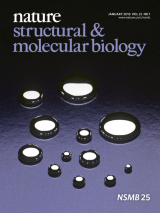
| January 2018 Volume 25, Issue 1 |
 | | |
 |  Editorial Editorial
News & Views
Review Articles
Articles
Technical Reports
| |
Editorial | |
|
 |
|
| NSMB at 25 p1
doi:10.1038/s41594-017-0017-1
IThis January 2018 issue starts the 25th year of NSMB's journey. We mark the occasion by launching a special series that celebrates the exciting research uncovering the fundamental principles behind biological processes. |
|
News & Views | |
|
| |
Articles | |
|
|
|
| Postmitotic nuclear pore assembly proceeds by radial dilation of small membrane openings pp21 - 28
Shotaro Otsuka, Anna M. Steyer, Martin Schorb, Jean-Karim Hériché, M. Julius Hossain et al.
doi:10.1038/s41594-017-0001-9
Ultrastructural analysis of nuclear membrane topology and assembling NPCs reveals how mitotic cells can rapidly establish a closed nuclear compartment while at the same time making it transport competent. |
|
|
|
| Two three-strand intermediates are processed during Rad51-driven DNA strand exchange pp29 - 36
Kentaro Ito, Yasuto Murayama, Masayuki Takahashi & Hiroshi Iwasaki
doi:10.1038/s41594-017-0002-8
Real-time FRET analyses and biochemical assays reveal that Rad51 recombinase promotes DNA strand exchange via two distinct three-strand intermediate states. |
|
|
|
| Cryo-EM structures of the human INO80 chromatin-remodeling complex pp37 - 44
Ricardo J. Aramayo, Oliver Willhoft, Rafael Ayala, Rohan Bythell-Douglas, Dale B. Wigley et al.
doi:10.1038/s41594-017-0003-7
The cryo-EM structure of the human INO80 chromatin-remodeling complex reveals the architecture of the complex centered around a RUVBL1–2 AAA+ heterohexamer. |
|
|
|
| APOBEC3 induces mutations during repair of CRISPR–Cas9-generated DNA breaks pp45 - 52
Liqun Lei, Hongquan Chen, Wei Xue, Bei Yang, Bian Hu et al.
doi:10.1038/s41594-017-0004-6
The APOBEC-AID family of cytidine deaminases target single-stranded nucleic acids for cytidine-to-uridine deamination and can thereby affect DNA repair processes that occur during CRISPR–Cas9-mediated genome editing. |
|
|
|
| Structural basis of TRPV5 channel inhibition by econazole revealed by cryo-EM pp53 - 60
Taylor E. T. Hughes, David T. Lodowski, Kevin W. Huynh, Aysenur Yazici, John Del Rosario et al.
doi:10.1038/s41594-017-0009-1
The cryo-EM structure of the full-length TRPV5 channel in complex with inhibitor econazole reveals a domain-swapped architecture and provides insights into mechanisms of inhibition. |
|
|
|
| Dominant-negative SMARCA4 mutants alter the accessibility landscape of tissue-unrestricted enhancers pp61 - 72
H. Courtney Hodges, Benjamin Z. Stanton, Katerina Cermakova, Chiung-Ying Chang, Erik L. Miller et al.
doi:10.1038/s41594-017-0007-3
Heterozygous cancer-associated SMARCA4 missense mutations disrupt conserved ATPase surfaces of this chromatin remodeler and alter the open chromatin landscape, thus inducing pro-oncogenic gene expression. |
|
|
|
| MLL2 conveys transcription-independent H3K4 trimethylation in oocytes pp73 - 82
Courtney W. Hanna, Aaron Taudt, Jiahao Huang, Lenka Gahurova, Andrea Kranz et al.
doi:10.1038/s41594-017-0013-5
During oogenesis, H3K4 trimethylation is targeted to genomic elements through transcription-dependent and transcription-independent mechanisms, the latter relying on MLL2 recruitment to unmethylated CpG-rich regions. |
|
|
|
| Nucleotide exchange factors Fes1 and HspBP1 mimic substrate to release misfolded proteins from Hsp70 pp83 - 89
Naveen K. C. Gowda, Jayasankar M. Kaimal, Roman Kityk, Chammiran Daniel, Jobst Liebau et al.
doi:10.1038/s41594-017-0008-2
Nucleotide exchange factors (NEFs) trigger substrate release from molecular chaperone Hsp70. The authors found that armadillo-type NEFs (yeast Fes1, human HspBP1) competitively prevent rebinding of released substrate. |
|
|
|
| Bap (Sil1) regulates the molecular chaperone BiP by coupling release of nucleotide and substrate pp90 - 100
Mathias Rosam, Daniela Krader, Christina Nickels, Janine Hochmair, Katrin C. Back et al.
doi:10.1038/s41594-017-0012-6
The ER-resident Hsp70 BiP is regulated by NEF Bap. The interactions between BiP and Bap are now dissected using biochemistry, molecular modeling and smFRET approaches, revealing that Bap affects both domains of BiP, to coordinate release of substrate and nucleotide. |
|
|
|
| Histone octamer rearranges to adapt to DNA unwrapping pp101 - 108
Silvija Bilokapic, Mike Strauss & Mario Halic
doi:10.1038/s41594-017-0005-5
Cryo-EM structures of nucleosomes in partially unwrapped, transient states reveal intrinsic plasticity that is required for nucleosome stability and can be exploited by chromatin-remodeling factors. |
|
Technical Reports | |
|
|
|
| RNA-DamID reveals cell-type-specific binding of roX RNAs at chromatin-entry sites pp109 - 114
Seth W. Cheetham & Andrea H. Brand
doi:10.1038/s41594-017-0006-4
RNA-DamID, a novel approach to detect lncRNA–genome interactions in vivo with high sensitivity and accuracy, demonstrates that the initial targeting of lncRNAs in the Drosophila dosage-compensation complex is cell-type specific. |
|
| | | | | | Natureevents is a fully searchable, multi-disciplinary database designed to maximise exposure for events organisers. The contents of the Natureevents Directory are now live. The digital version is available here.
Find the latest scientific conferences, courses, meetings and symposia on natureevents.com. For event advertising opportunities across the Nature Publishing Group portfolio please contact natureevents@nature.com | | | | | | |
|









No comments:
Post a Comment