Advertisement |
 |
Get pipetting help from the experts. With over 55 years of experience in liquid handling, Eppendorf has a massive knowledge base of proper pipetting techniques and other solutions to solve just about any liquid handling challenge you face.
Learn more from the Liquid Handling experts and check out our pipetting solutions today. |  | | |
|
 |
TABLE OF CONTENTS
|
November 2018 Volume 15, Issue 11 |
 | | |
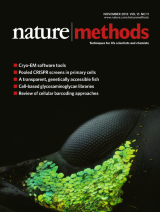 |  Editorial Editorial
This Month
Correspondence
Comment
Research Highlights
Technology Feature
News & Views
Review Articles
Resources
Brief Communications
Articles
Amendments & Corrections
| | | Advertisement | | | |  Optimize your antibody applications with CST Guides to assist you with your research: IHC, ChIP, IF, and WB. Optimize your antibody applications with CST Guides to assist you with your research: IHC, ChIP, IF, and WB.
Download these guides to improve your results, select better suited antibodies, get easy-to-use protocols and find the best companion products for each. | | |
| |
| Advertisement |
|
| |
|
| |
Editorial | |
| |
 |
|
The impact of the NIH BRAIN Initiative p839
doi:10.1038/s41592-018-0210-0
|
|
This Month | |
| |
|
|
Anna Moroni p841
Vivien Marx
doi:10.1038/s41592-018-0192-y
|
|
|
|
Predicting with confidence and tolerance pp843 - 845
Naomi Altman & Martin Krzywinski
doi:10.1038/s41592-018-0196-7
|
|
| Advertisement |
|
Advanced Imaging with Proven Optics
Olympus is dedicated to your work, vision, and science. Through innovation and service, we seek to aide in your discoveries, advance your research, and inspire you to explore new possibilities. Our wide range of microscopes are built with the optical excellence and proven application expertise you can depend on. Your Science Matters™.
> Learn more about Olympus microscopes |  | | |
|
| |
Correspondence | |
| |
|
|
A community-developed open-source computational ecosystem for big neuro data pp846 - 847
Joshua T. Vogelstein, Eric Perlman, Benjamin Falk, Alex Baden, William Gray Roncal et al.
doi:10.1038/s41592-018-0181-1
|
|
|
|
Striped UniFrac: enabling microbiome analysis at unprecedented scale pp847 - 848
Daniel McDonald, Yoshiki Vázquez-Baeza, David Koslicki, Jason McClelland, Nicolai Reeve et al.
doi:10.1038/s41592-018-0187-8
|
|
|
 |
Comment | |
| |
|
|
A call for public archives for biological image data pp849 - 854
Jan Ellenberg, Jason R. Swedlow, Mary Barlow, Charles E. Cook, Ugis Sarkans et al.
doi:10.1038/s41592-018-0195-8
|
|
Research Highlights | |
| |
| |
Technology Feature | |
| |
|
|
Neuroscience models: choose your dimension pp863 - 866
Vivien Marx
doi:10.1038/s41592-018-0191-z
|
|
News & Views | |
| |
| |
Review Articles | |
| |
|
|
Cellular barcoding: lineage tracing, screening and beyond pp871 - 879
Justus M. Kebschull & Anthony M. Zador
doi:10.1038/s41592-018-0185-x
A review of cellular barcoding fundamentals and applications, including powerful approaches for lineage reconstruction, genetic screening, and the recording of cellular activity and neuroanatomy. |
|
Resources | |
| |
|
|
The GAGOme: a cell-based library of displayed glycosaminoglycans pp881 - 888
Yen-Hsi Chen, Yoshiki Narimatsu, Thomas M. Clausen, Catarina Gomes, Richard Karlsson et al.
doi:10.1038/s41592-018-0086-z
A CHO cell library displaying a near-complete repertoire of glycosaminoglycan (GAG) modifications provides a resource for cell-based binding assays, recombinant proteoglycan expression, and assembly of GAG glycan microarrays. |
|
|
|
A mutant-cell library for systematic analysis of heparan sulfate structure–function relationships pp889 - 899
Hong Qiu, Songshan Shi, Jingwen Yue, Meng Xin, Alison V. Nairn et al.
doi:10.1038/s41592-018-0189-6
A library of mutant mouse lung endothelial cells expressing a comprehensive repertoire of heparin sulfate structure modifications enables studies of the structure–function relationships of this complex polysaccharide. |
|
Brief Communications | |
| |
|
|
The hit-and-return system enables efficient time-resolved serial synchrotron crystallography pp901 - 904
Eike C. Schulz, Pedram Mehrabi, Henrike M. Müller-Werkmeister, Friedjof Tellkamp, Ajay Jha et al.
doi:10.1038/s41592-018-0180-2
A data-collection strategy using a fixed-target crystallography chip allows time-resolved serial synchrotron crystallography experiments to determine enzyme intermediate structures with time resolutions of milliseconds to seconds. |
|
|
|
A fully automatic method yielding initial models from high-resolution cryo-electron microscopy maps pp905 - 908
Thomas C. Terwilliger, Paul D. Adams, Pavel V. Afonine & Oleg V. Sobolev
doi:10.1038/s41592-018-0173-1
A fully automated method for modeling protein and protein–RNA complex structure from cryo-EM data, requiring minimal user intervention, is described. |
|
|
|
A high-throughput pipeline for validation of antibodies pp909 - 912
Krzysztof Sikorski, Adi Mehta, Marit Inngjerdingen, Flourina Thakor, Simon Kling et al.
doi:10.1038/s41592-018-0179-8
This paper describes a platform for carrying out antibody-based capture and mass spectrometry in parallel, and tests the feasibility of this platform for high-throughput validation of antibodies. |
|
|
|
Analyzing complex single-molecule emission patterns with deep learning pp913 - 916
Peiyi Zhang, Sheng Liu, Abhishek Chaurasia, Donghan Ma, Michael J. Mlodzianoski et al.
doi:10.1038/s41592-018-0153-5
The deep neural network smNet extracts multiplexed parameters such as 3D position, orientation and wavefront distortion from emission patterns of single molecules. |
|
|
|
Label-free prediction of three-dimensional fluorescence images from transmitted-light microscopy pp917 - 920
Chawin Ounkomol, Sharmishtaa Seshamani, Mary M. Maleckar, Forrest Collman & Gregory R. Johnson
doi:10.1038/s41592-018-0111-2
Convolutional neural networks enable prediction of fluorescently labeled structures from three-dimensional time-lapse transmitted-light images. Applications include multiplexed long time-lapse imaging and prediction of fluorescence in electron micrographs. |
|
|
|
FLIRT: fast local infrared thermogenetics for subcellular control of protein function pp921 - 923
Sophia M. Hirsch, Sriramkumar Sundaramoorthy, Tim Davies, Yelena Zhuravlev, Jennifer C. Waters et al.
doi:10.1038/s41592-018-0168-y
FLIRT enables spatiotemporally precise control of protein function in C. elegans by harnessing existing temperature-sensitive mutations. Proteins can be inactivated at desired sites by infrared laser light targeted to the region(s) of interest. |
|
|
|
Engineered anti-CRISPR proteins for optogenetic control of CRISPR–Cas9 pp924 - 927
Felix Bubeck, Mareike D. Hoffmann, Zander Harteveld, Sabine Aschenbrenner, Andreas Bietz et al.
doi:10.1038/s41592-018-0178-9
CASANOVA uses LOV and blue light to regulate CRISPR activity. |
|
|
|
CRISPR-Sirius: RNA scaffolds for signal amplification in genome imaging pp928 - 931
Hanhui Ma, Li-Chun Tu, Ardalan Naseri, Yu-Chieh Chung, David Grunwald et al.
doi:10.1038/s41592-018-0174-0
Multiple MS2 loops inserted in the first loop of an sgRNA after the spacer sequence stabilize the sgRNA and allow recruitment of multicolor fluorescent proteins for imaging of low-repeat genomic loci. |
|
|
|
Spatial organization of the somatosensory cortex revealed by osmFISH pp932 - 935
Simone Codeluppi, Lars E. Borm, Amit Zeisel, Gioele La Manno, Josina A. van Lunteren et al.
doi:10.1038/s41592-018-0175-z
osmFISH applies automated cycles of single-molecule fluorescence in situ hybridization without barcoding to provide spatial gene expression in tissue sections at high sensitivity, accuracy and throughput. |
|
|
|
Stability, affinity, and chromatic variants of the glutamate sensor iGluSnFR pp936 - 939
Jonathan S. Marvin, Benjamin Scholl, Daniel E. Wilson, Kaspar Podgorski, Abbas Kazemipour et al.
doi:10.1038/s41592-018-0171-3
Variants of the genetically encoded sensor iGluSnFR extend the range of conditions under which glutamate neurotransmission can be visualized. In addition, chromatic variants of iGluSnFR improve compatibility with various illumination schemes. |
|
Articles | |
| |
|
|
Guide Swap enables genome-scale pooled CRISPR–Cas9 screening in human primary cells pp941 - 946
Pamela Y. Ting, Albert E. Parker, J. Scott Lee, Chris Trussell, Orzala Sharif et al.
doi:10.1038/s41592-018-0149-1
Guide Swap challenges the hypothesis that Cas9–sgRNA binding is irreversible. The authors find that instead, nontargeting sgRNAs are swapped for targeting sgRNAs in the Cas9 complex. The method allows genome-scale functional screens in primary cells |
|
|
|
De novo computational RNA modeling into cryo-EM maps of large ribonucleoprotein complexes pp947 - 954
Kalli Kappel, Shiheng Liu, Kevin P. Larsen, Georgios Skiniotis, Elisabetta Viani Puglisi et al.
doi:10.1038/s41592-018-0172-2
DRRAFTER, a method for RNA modeling into cryo-EM maps, generates accurate models for diverse RNA–protein complexes. |
|
|
|
emClarity: software for high-resolution cryo-electron tomography and subtomogram averaging pp955 - 961
Benjamin A. Himes & Peijun Zhang
doi:10.1038/s41592-018-0167-z
A software tool, emClarity, implements several improvements in cryo-electron tomography image-processing algorithms to achieve sub-nanometer resolution for diverse macromolecular structures. |
|
|
|
Species-level functional profiling of metagenomes and metatranscriptomes pp962 - 968
Eric A. Franzosa, Lauren J. McIver, Gholamali Rahnavard, Luke R. Thompson, Melanie Schirmer et al.
doi:10.1038/s41592-018-0176-y
HUMAnN2 uses a tiered sequence search to provide rapid and accurate species-level functional profiles of microbial communities from metagenomic and metatranscriptomic data. |
|
|
|
A light-gated potassium channel for sustained neuronal inhibition pp969 - 976
Laura Alberio, Andrea Locarno, Andrea Saponaro, Edoardo Romano, Valérie Bercier et al.
doi:10.1038/s41592-018-0186-9
BLINK2 is a light-activated potassium channel for optogenetic inhibition of neuronal activity. Alberio et al. apply the tool in systems as diverse as cultured rat neurons, mouse brain slices, behaving zebrafish and a rat model of neuropathic pain. |
|
|
|
Transparent Danionella translucida as a genetically tractable vertebrate brain model pp977 - 983
Lisanne Schulze, Jörg Henninger, Mykola Kadobianskyi, Thomas Chaigne, Ana Isabel Faustino et al.
doi:10.1038/s41592-018-0144-6
The combination of transparency, small brain size and genetic access positions Danionella translucida as a promising model organism for functional imaging of neuronal circuits, especially during complex behaviors in adults. |
|
Amendments & Corrections | |
| |
|
|
Publisher Correction: Image Data Resource: a bioimage data integration and publication platform p984
Eleanor Williams, Josh Moore, Simon W Li, Gabriella Rustici, Aleksandra Tarkowska et al.
doi:10.1038/s41592-018-0169-x
|
|
|
|
Publisher Correction: Precision and accuracy of single-molecule FRET measurements—a multi-laboratory benchmark study p984
Björn Hellenkamp, Sonja Schmid, Olga Doroshenko, Oleg Opanasyuk, Ralf Kühnemuth et al.
doi:10.1038/s41592-018-0193-x
|
|
| Advertisement |
|
Nature Briefing is an essential round-up of science news, opinion and analysis, free in your inbox every weekday. With Nature Briefing, we'll keep you updated on the latest research, so you can focus on yours.
Click here to sign up. |  | | |
|
| |
| | | | | | Natureevents is a fully searchable, multi-disciplinary database designed to maximise exposure for events organisers. The contents of the Natureevents Directory are now live. The digital version is available here.
Find the latest scientific conferences, courses, meetings and symposia on natureevents.com. For event advertising opportunities across the Nature Publishing Group portfolio please contact natureevents@nature.com | | | | | | |
|


No comments:
Post a Comment